
TBC introduces… Pete Roth Trio
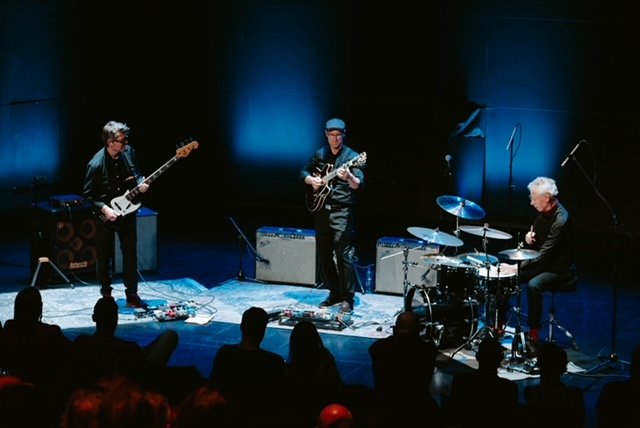
What a couple of years it has been for you. From those early one-off shows, to a more concerted if still tentative touring itinerary in '25, to spreading your wings into Europe, Japan, and now Canada - not to mention Luton. How has it felt to be out on the road, and are you still sticking to your goal of playing only intimate spaces that lend themselves to the sharing of the musical experience with the audience?
The last couple of years have been a real rollercoaster. What began as a few one-off shows quickly grew into a small tour, with one of our earliest stops being The Bear Club in Luton. At that point, we were still defining what the band was and what it could become.
Since then, things have expanded organically. We’ve had the privilege of playing internationally, from the San Sebastián Jazz Festival, where we were televised nationally in Spain, to venues such as the Blue Note in Milan, as well as Austria, Germany, France, Scandinavia, Italy, Japan, and even Miami, where the response was incredible.
It has become a genuinely global band, often playing to sold-out rooms, and the music has been able to develop in a very rare way, in real time, with audiences. The audience has effectively become a fourth voice in the music.
We still value intimacy, though the scale is increasing. On our upcoming Canada tour, we are playing venues of up to 900 seats, so balancing scale with closeness is becoming more of a challenge, but still central to what we do.
Your project, since Bill Bruford came on board, seems to have been to stretch out with the music - to bring your collective chops to bear on an eclectic repertoire, from your own compositions to Gershwin to Parker and even Dvorak. You use the core components of the music as a jumping-off point, though, and the free elements of improvisation are what really turn your live shows into an experience. How has that approach remained fresh now that you have been playing together more regularly?
The band’s material is deliberately eclectic, drawing on our musical backgrounds and the shared influences we all connect with. At the core is jazz, particularly its language of interaction and free improvisation. Each performance is built in real time, shaped by the room, the moment, and the audience.
We work with melodic or rhythmic frameworks, but these are only starting points. From there, the music is allowed to move freely, often in unexpected directions. The audience plays a crucial role in this. Their energy directly influences how far we go. If the room is open and engaged, we push further; if it’s more reserved, we may draw things in and focus the energy differently. It becomes a genuine feedback loop.
In a world of highly produced, fixed performances, we value that sense of risk and immediacy, something that exists only in that room, at that time.
Are there any new additions to the repertoire for this run of dates that we ought to be looking out for?
There is a good amount of new material, alongside reworked pieces from earlier in the project.
Roughly a quarter to a third of the repertoire evolves on each run of shows. Some older pieces have been significantly reimagined, so even familiar material now functions in a different way. We’ve largely moved away from traditional jazz standards, except for a couple that have been so extensively reworked they now feel like part of our own language.
Overall, the set is constantly shifting; it’s designed to stay alive and to respond to the energy of each night.
Your music has been described as "brilliantly unruly" and, to some extent, is uncategorisable, combining elements of straight-ahead jazz, free jazz, prog, jazz rock fusion, classical, and funk. All three of you bring a wealth of experience and knowledge of all these genres and more. How do you think of the music, and do you see musical labels as bear traps (pun intended)?
I really like the description “brilliantly unruly”; it feels accurate in a good way.
Within the trio, Bill is perhaps the most brilliantly unruly element in the best possible sense. He has a remarkable ability to see beyond the surface of the music and identify its deeper intent, almost like adjusting the focus of a lens until the concept becomes clear. That clarity is key. It’s not about complexity for its own sake, but about defining what a piece is trying to be, and then allowing everything else to serve that idea.
Once that framework is established, genre becomes secondary. Whether something draws from jazz, rock, classical, funk, or fusion is less important than the internal logic of the piece.
That ongoing process of refinement, deciding what belongs and what doesn’t, is what keeps the music focused, but also makes it difficult to label. We are not trying to fit into categories. We are trying to develop a clear collective identity.
What can we expect from your show at The Bear this time around?
We’re very excited to return to The Bear Club. We had a fantastic experience there last time, an incredibly attentive and responsive audience, and a venue that allows for real closeness and communication. These kinds of intimate spaces are becoming rarer for us as the project grows, so nights like this remain very special.
For this run, we also have Stefan Redtenbacher joining us on bass in place of Mike Pratt. Stefan is a true virtuoso and a highly established musician in his own right, and we’re thrilled to have him with us. Mike is currently recovering from minor surgery, and we look forward to welcoming him back when he is fully fit.
The music hasn’t become any quieter, quite the opposite, so audiences should expect a very direct, high-energy, and immersive experience. It’s not a passive concert; it’s a shared space of exploration in real time. We can’t wait to be back.
Pete joins us with his trio on Thursday 4 June 2026